



AARP Hearing Center




























































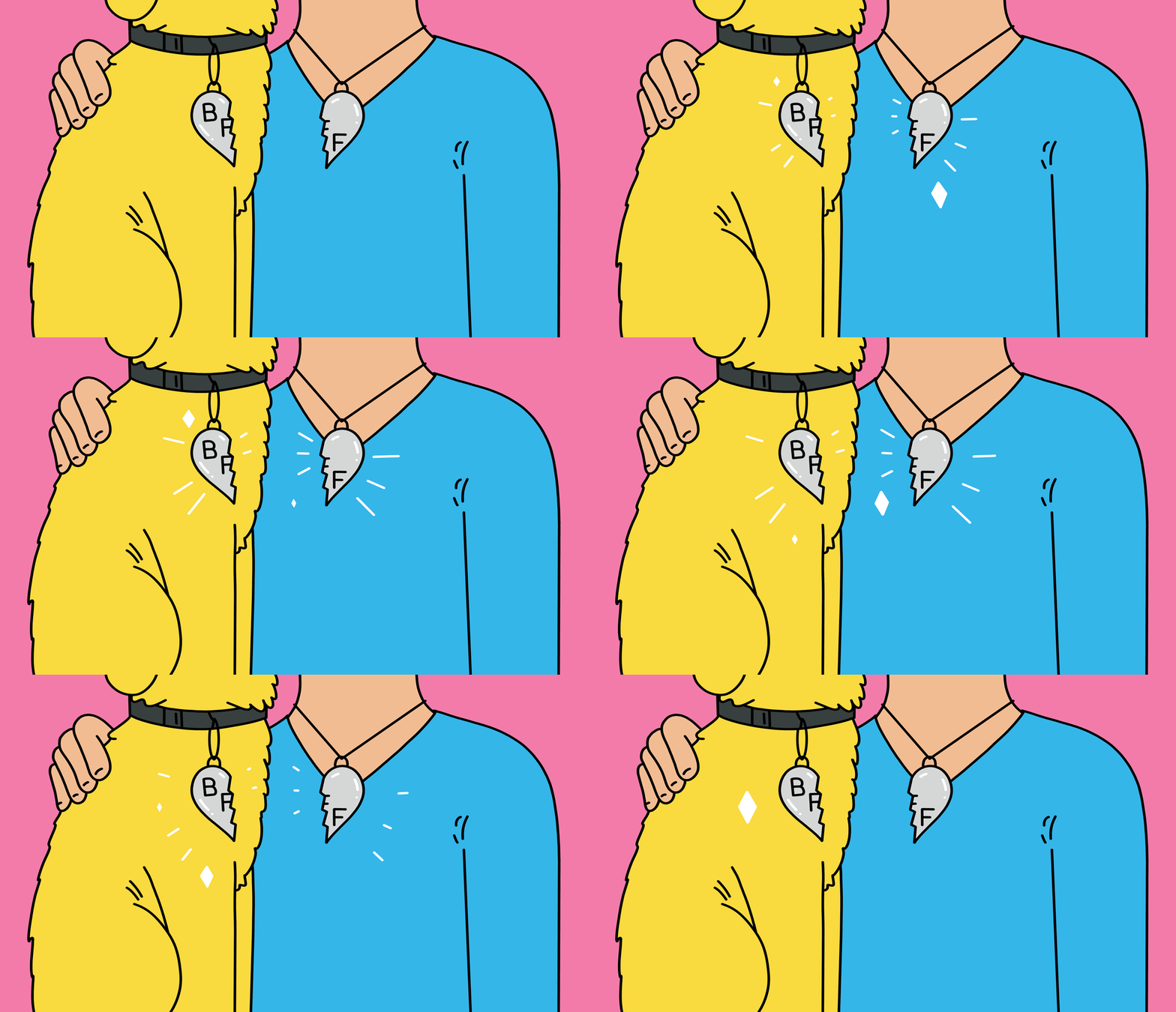
From using positive reinforcement to remembering they aren't human, how you treat and train your dog can determine your bond.
Sam Island
Dogs can be our best friends as we age. They get us off the couch and out for walks, stave off loneliness and give us a sense of purpose. There’s even scientific evidence that owning a dog boosts our cardiovascular health, so it’s good for our hearts in more ways than one, says the American Heart Association. Â
It’s a guaranteed best friend, right? Not exactly. While dogs have a particular talent for bonding with other species, including humans, that bond isn’t guaranteed. How you train them and treat them can affect your connection.
Here are 25 tips from experts on how to nurture your furr-ever love with your dog.Â
1. Recognize a good bond
Wondering what kind of bond you have with your dog right now? Your dog will let you know, says Caroline Walsh, a guide dog mobility instructor with Guiding Eyes for the Blind, who works with dog and human clients. If a dog is happy to be around you, they’ll wag their tail and be excited (and maybe give kisses), or their body language will be super calm and they’ll have a low-set tail.Â
But understand there’s a difference between having a healthy bond with your dog and being attached like Velcro, says Victoria Schade, author of Bonding With Your Dog and the official trainer for the Puppy Bowl, Animal Planet’s annual nod to the Super Bowl. “You want your dog to be brave, independent and curious about the world without needing to experience it as your shadow,†she says. “Dogs need downtime at home, alone, to decompress. Taking them everywhere isn’t good for them.â€
2. Understand why bonding is important
Think of it as circular: A good bond means the time you spend together is more enjoyable and satisfying for you and your dog. In turn, that bond encourages you to spend more time together, which deepens it more, trainers and animal behaviorists say.
“An owner doesn’t want to live with a dog they don’t like,†says Mary Burch, a certified applied animal behaviorist and director of the American Kennel Club’s Family Dog Program. “A dog doesn’t want to live with an owner that doesn’t spend any time with it, and doesn’t do what the dog wants to do, and doesn’t meet the physical needs of exercise, and so on. Bonding causes a better relationship.â€Â 
3. Consider your dog an individual, not just a breed
Don’t assume a certain breed will guarantee a particular behavior or a strong bond. Perhaps you always thought you preferred Labrador retrievers, dachshunds or whatever breed you’ve had in the past because you like that breed’s personality. But research by Darwin’s Ark, a community science initiative founded by scientists at the Broad Institute of MIT and Harvard and UMass Chan Medical School, found there can be more variation in personality among individual dogs of the same breed than among individual dogs of different breeds.Â
“[Breed] really doesn’t tell you about behavior,†says Kathryn Lord, one of the research specialists. You might choose a golden retriever puppy, for example, because they have a reputation for being friendly family dogs. But that puppy’s long-term behavior has more to do with how you raise it and train it than the fact that it’s a golden retriever.
4. Remember your age
What may have seemed adorable at age 35 — My dog jumps and welcomes me every time I come home! — might be annoying and even dangerous as we get older. Laurie C. Williams, a dog trainer and behaviorist who owns Pup ’N Iron Canine Enrichment Center in Fredericksburg, Virginia, says older clients sometimes complain that a new dog is a “demon puppy†that’s not as well-behaved as every other dog they've owned. She assures them that there’s nothing wrong with the puppy. The humans, however, have changed: Their physical abilities may be different, and they might not have as much patience with a young dog. Williams teaches older owners skills that make busy dogs more manageable, such as burning off energy before a walk with scent games. Or using a flirt pole — a toy attached by a tether to the end of a pole — like a heavy-duty cat toy.
“You could literally stand in one spot and just swing it back and forth, and your dog will chase it like nobody’s business,†says Williams. Or sit in a chair, tell the dog to sit, and when it does, throw a treat across the room so it has to expend energy to get it. 

To fend off destructive behavior, choose activities that give your dog a chance to do what they love (dig, rip stuff apart).
Sam Island
5. Find acceptable activities for innate behaviors
You buy your dog a toy, and before you know it, clumps of stuffing are being tossed around the living room like cotton candy. But being constantly upset about the destruction of toys (or your house) threatens a bond. Help your dog find safe and acceptable ways to express innate behaviors like stalking, chasing, shaking, grabbing or dissecting prey — all things they did when they lived outdoor lives, says Lord. If your dog really likes to dissect, give them toys they can pull apart safely. If they like to chase, throw balls. Or if they only like to grab after they’ve chased for a long time, try a Frisbee.Â
“Some dogs like to dig. Some dogs like to use their nose. Some dogs like to use their paws. You can find which things work for your dog, and then you can match the enrichment to that,†Lord says. “So that can be a good way to bond. That’s driven by evolutionary science.â€Â
6. It’s all about time
Time together is the most important tool you have to create a good bond with your dog, says Burch. Training, riding in cars, playing games, going to the park and sharing other activities with your dog results in a lower likelihood of problem behaviors, disobedience, destruction and excitability. Does vegging out on the couch with your pup count? While it’s a nice snuggle time, Burch recommends doing more active things with your dog for at least 30 minutes a day. Need some motivation? Enroll in something you’d both like, such as the AKC Fetch program, in which your dog can earn titles, or AKC FIT, which encourages you to get outside and walk with your dog, either with a group or on your own, says Burch. Â
And be aware that while doggy day care or a dog walker may be convenient and gets your dog up and out, it’s not helping you to bond with your pup, says Clive Wynne, a psychology professor who directs the Canine Science Collaboratory at Arizona State University and wrote Dog Is Love, a book about the human-and-dog connection.
7. Use positive reinforcement, not ‘correction’Â
Positive-reinforcement training encourages bonding because it teaches the dog that all good things come from your affection, toys, playtime and food. “They follow your instructions because they want that, as opposed to following your instructions because they’re afraid of what’s going to happen,†says Williams. “It is a completely different mindset.â€Â She uses a mantra of “predict, prevent, redirect.â€Â Instead of jerking a dog’s leash to correct an unwanted behavior — jumping on people, for example — she seeks to prevent that action by predicting the behavior (the dog’s going to jump on visitors) and redirecting it (teaching the dog a different response, such as “sit,†when greeting visitors).
Mark the behavior you want with a clicker or a word like “yes,†then reinforce it with a treat. Eventually, your dog will actually start offering that behavior instead of jumping, without even being told. Older owners may want to forgo the clicker and use a word; it means one less thing to have to worry about in your hands, Williams says.Â


You Might Also Like
How to Adopt a Rescue Dog — The Hard Way
After spending a year tracking another family’s runaway pet, this couple ended up with him
Insider Secrets From a Dog Trainer
From barking only once to how to drop something, here’s what to know
How the Dog Park Helped Me Fetch New Friends
It's a place where people can connect over a shared interest