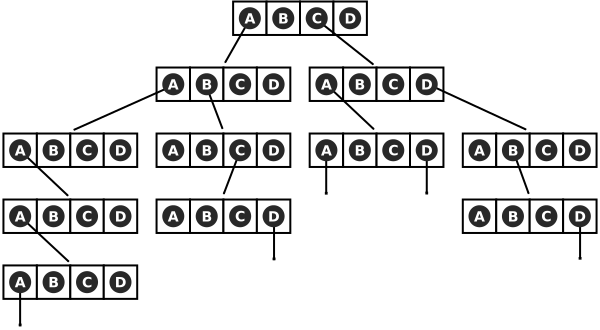
- Keyword Tree based on the prefix of a string. N-ary Tree in essence.
- Each node consists of at max 26 children and edges connect each parent node to its children.
- We need to mark the last node of every key as end of word node.
- Insert
- Every character of the input key is inserted as an individual Trie node.
- The key character acts as an index into the aray children.
- Costs: O(k), k is the key length
- Search
- Compare characters and move down.
- Searching termination:
- Reach the end of the string
- Lack of key in the trie.
- Costs: O(k), k is the key length
The memory requirements of Trie is O(AlphabetSize * keyLength * N) where N is number of keys in Trie.
- Also called Disjoint Set
- It keeps track of a set of elements partitioned into a number of disjoint(non-overlapping) subsets.
- Find
- Determine which subset a particular element is in.
- Union
- Join two subsets into a single subset.
It runs two simutaneous search to find smallest path from source to goal vertex.
- Forward search from source vertex toward goal vertex.
- Backward search from goal vertex toward source vertex.
The search terminates when two graphs intersect.
- Both initial and goal states are unique and completely defined.
- The branching factor is exactly the same in both directions.
- Optimize path-finding and graph traversal.
- Problem: Consider a square grid having many obstacles and we are given a starting cell and a target cell. We want to reach the target cell (if possible) from the starting cell as quickly as possible.
- A* search: at each step it picks the node according to a value - f which is a parameter equal to the sum of two other parameters - g and h. At each step it picks the node/cell having the lowest f, and process that node/cell.
-
A binary search tree with one extra attribute for each node: the color.
class TreeNode { TreeNode left; TreeNode right; int val; boolean color; } -
Properties:
- Every node is either red or black.
- Every leaf is black.
- If a node is red, then both its children are black.
- Every simple path from a node to a descendant leaf contains the same number of black nodes.
- A height balancing binary search tree.
- AVL tree checks the height of the left and the right sub-trees and assures that the difference is not more than 1.