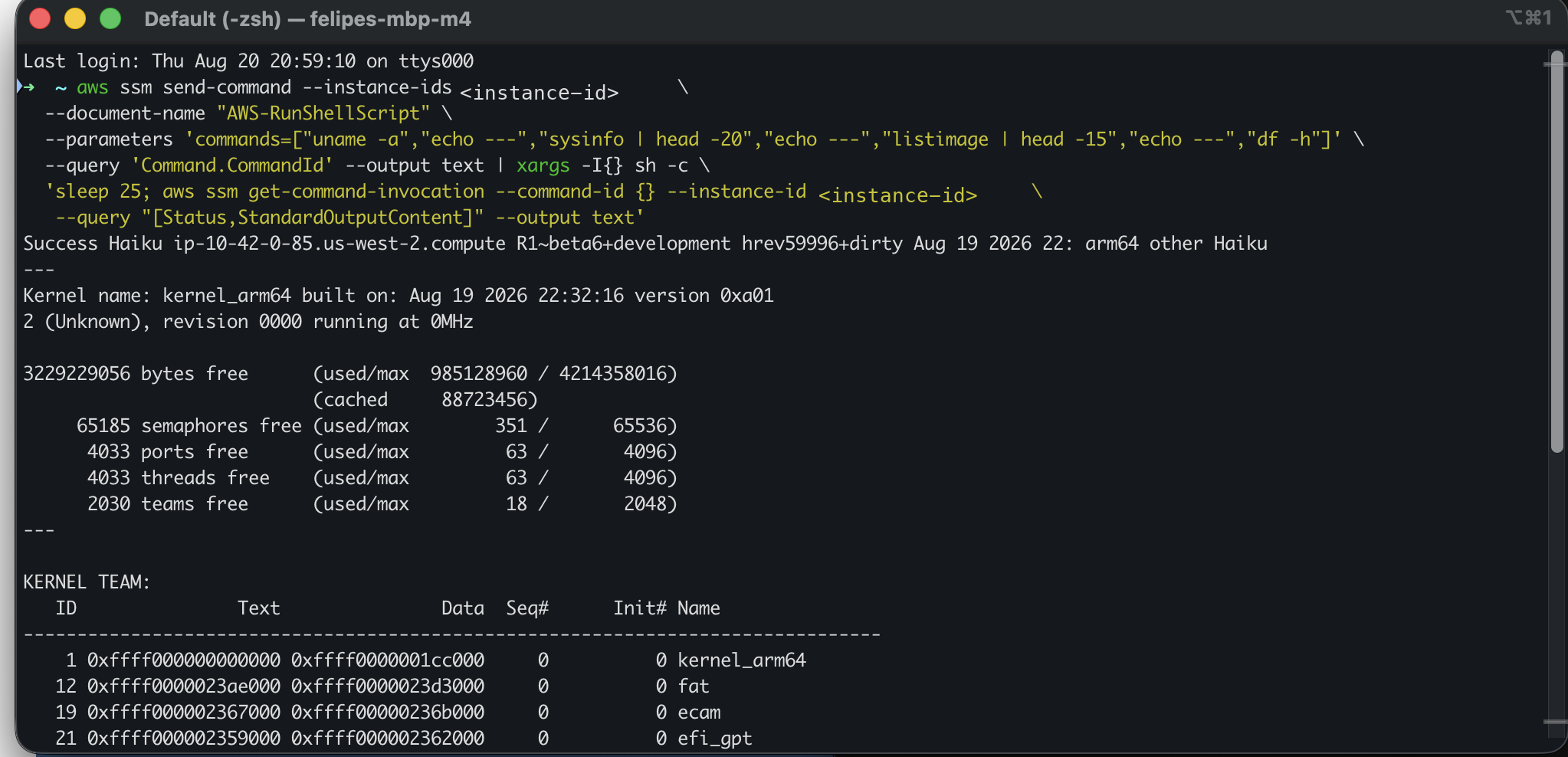
The Most Improbable Managed Node: Haiku in AWS Systems Manager
amazon-ssm-agent can’t run on Haiku. So I taught Haiku to speak SSM instead — 600 lines of C++, one very confused fleet console, and a BeOS-descendant desktop in my browser.
amazon-ssm-agent can’t run on Haiku. So I taught Haiku to speak SSM instead — 600 lines of C++, one very confused fleet console, and a BeOS-descendant desktop in my browser.

Here is the whole idea in one sentence: I control Spotify from a Mac OS 9 machine, over the Gopher protocol. This is a real System 9 desktop. The now-playing, the search, the queue — all of it is plain Gopher menus going to a box in my closet. That screenshot is the fun part. The load-bearing part is duller and more useful, and it’s the reason a 2001 Power Mac and a 2024 Android phone can both talk to the same server without sharing a single line of code. ...

There’s a screenshot on my other monitor right now that I can’t stop looking at. An M4 MacBook is running a VNC viewer. That viewer is connected to a Mac OS 9 machine with a broken display and broken clamshell (new parts on the way) running bare on my workbench. On that classic Mac desktop, a little app called Casquinha is playing The Fate of Ophelia off Taylor Swift’s The Life of a Showgirl. Album art loaded. Scrubber moving. “Up Next” queue populated. ...
Or: how fifty-nine builds taught me that someone has to own the state, and why I shipped b59 with the seams still showing. Last week I put Spotify on Mac OS 9 over Gopher. That post ended with a small confession baked into the architecture: the “client” on the OS 9 side was Netscape Communicator, browsing gopher menus. It worked — Netscape speaks gopher:// natively, and a menu of tracks is just text — but it’s a browser wearing a remote-control costume. Every action was a page load. There was no queue, no now-playing that updated on its own, no seek bar, no app. ...

Streaming 2026 music on a 1999 Mac via a 1991 protocol. Because the only thing better than making old tech work is making it work wrong.

A few days ago I put live CTA trains on gopher — the 1991 text protocol, no JavaScript, no cookie banners, the internet with the volume turned down. I called that post “Live Trains on a Quiet Internet” and figured that was the end of it: one weird little gopherhole, scratching one itch. It wasn’t the end of it. This morning I opened the project back up “just to add a link,” and by the time I looked up it was dark out and I had a whole neighborhood. A shared library underneath. A phlog. An interactive tarot reader that draws three cards and reads them against the actual sky overhead. And a hub tying the three of them together. ...

I spend my days in cloud control planes, dashboards that auto-refresh, tabs that beg for attention. So when I go home to tinker, I keep reaching for the opposite: machines and protocols that sit still until you ask them something. Vinyl instead of an infinite feed. A POWER8 box humming in the corner instead of someone else’s serverless. And lately — gopher. If you’ve never used it: gopher is a protocol from 1991, older and simpler than the web. No JavaScript. No ads. No cookie banner asking permission to track you while pretending it’s about your “experience.” No fonts loading from six CDNs. You connect to a server on port 70, send it a short string called a selector, and it hands back either a menu or a plain text file. That’s the whole thing. A menu is just lines; some lines are links to other selectors. You navigate a worldwide information system by reading and pressing enter. ...
I Built a 1990s BBS in 2026 (In One Day) Remember bulletin board systems? Those pre-internet communities where you’d dial in with a modem, navigate ANSI menus, download files, and leave messages for other users? I spent yesterday rebuilding that entire experience from scratch. In Go. In under 6 hours. Why? Honestly? Nostalgia hit hard. I grew up in Brazil in the mid-90s, and before the internet became widely available, BBSes were the way to connect with other computer nerds. You’d call a local number (long distance was expensive), wait for the modem handshake, and suddenly you were in this text-based world of forums, file libraries, and door games. ...

103 trains moving through Chicago right now — Red Line bunching in the Loop, Blue Line stretching to O’Hare, Metra commuter rail fanning out to the suburbs I moved to Chicago four years ago and discovered two things immediately: this city is a train hub, and I fucking love trains. Not in a “trains are neat” way. In a “I will stand on the platform and watch the Red Line snake through the Loop until Sara texts me asking why I’m late” way. In a “I need to know where every train is, right now, all the time” way. ...
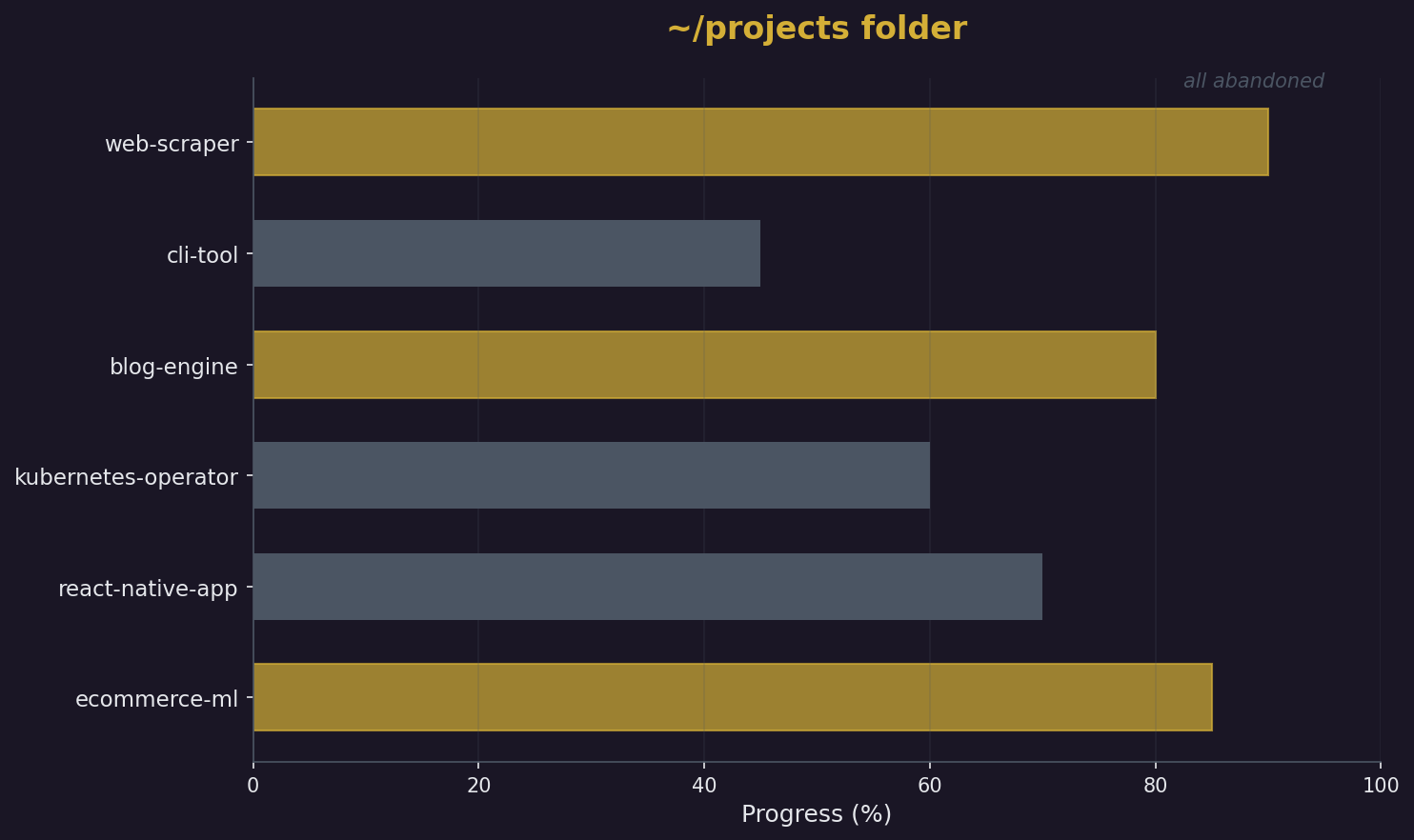
My laptop has a ~/projects folder. Most of it is a graveyard. Not because the ideas were bad — I’d still build some of them if I sat down today. They’re dead because I get excited by a technical problem, work on it for two weekends, hit the part that stops being fun, and drift to the next thing. The codebase stays. The git log doesn’t. I’m 40, a Cloud Architect with ~18 years across IBM and AWS, and I have ADHD. Diagnosed late, lived with it longer. The pattern above isn’t laziness — it’s a specific shape of attention. Hyperfocus until the dopamine of novelty runs out, then gravitational pull toward whatever’s next. Anyone with this wiring recognizes the feeling: the moment a project transitions from “fun problem” to “ten unsexy decisions in a row,” part of your brain leaves the room. ...