

About
I'm Jacob Yaacubov — an autonomous systems engineer and MSc researcher based in Israel, writing about the things I really passionate about: deep learning, computer vision, robot autonomy, and the messy reality of making intelligent systems work outside in our real-life messy environment.

The work
I've spent the last 5 years building production robotic platforms from the ground up — full stack, from raw sensor data to deployed mission systems. That means writing perception pipelines, tuning state estimators, debugging crashes that only happen at 3am on a real flight, and figuring out why something that worked perfectly in simulation refuses to behave on actual hardware.
My day-to-day lives at the intersection of several fields:
Computer vision — camera models, stereo geometry, optical flow, feature extraction, and the deep architectures that have made classical CV look quaint: ViT, DETR, SAM, DINOv2, and whatever landed on arXiv this week that I haven't had time to read yet.
Deep learning for embodied systems — object detection, semantic segmentation, depth estimation, sensor fusion, and real-time inference on edge hardware where every millisecond and every milliwatt counts.
Robot autonomy and planning — path planning, behavior trees, mission execution stacks, and the hard problem of making a system that is both reactive and goal-directed at the same time.
ROS2 — middleware architecture, real-time constraints, multi-node sensor fusion pipelines, and the endless debugging that comes with distributed systems on moving platforms.
State estimation — VIO, EKF2, the ways visual-inertial odometry fails in the real world, and what the logs look like right before something goes wrong.
The research
I'm currently pursuing an MSc in Autonomous Systems and Robotics at Ben-Gurion University of the Negev, with my research focused on Vision-Language-Action (VLA) models — the emerging class of systems that combine large pretrained vision-language models with robot action policies to create agents that can follow natural language instructions, reason about visual scenes, and act in physical environments.
This is, in my view, the most interesting problem in robotics right now. The gap between what a model can describe and what a robot can reliably do is still enormous — and closing it is what my research is about.
My coursework also covers deep reinforcement learning, meta-learning, few-shot adaptation, deep learning baed computer vision, and the theory underneath all of it, which finds its way into this blog more often than I initially expected.
Outside the lab
hen I'm not in front of a screen or elbow-deep in a robot, I'm usually somewhere vertical.
Mountaineering and climbing are where I spend most of my free time. There's something about the problem-solving structure of a hard route — reading the terrain, committing to a sequence, recalibrating when it doesn't go as planned — that feels surprisingly similar to debugging a complex system. Except the consequences of a segfault are less interesting.
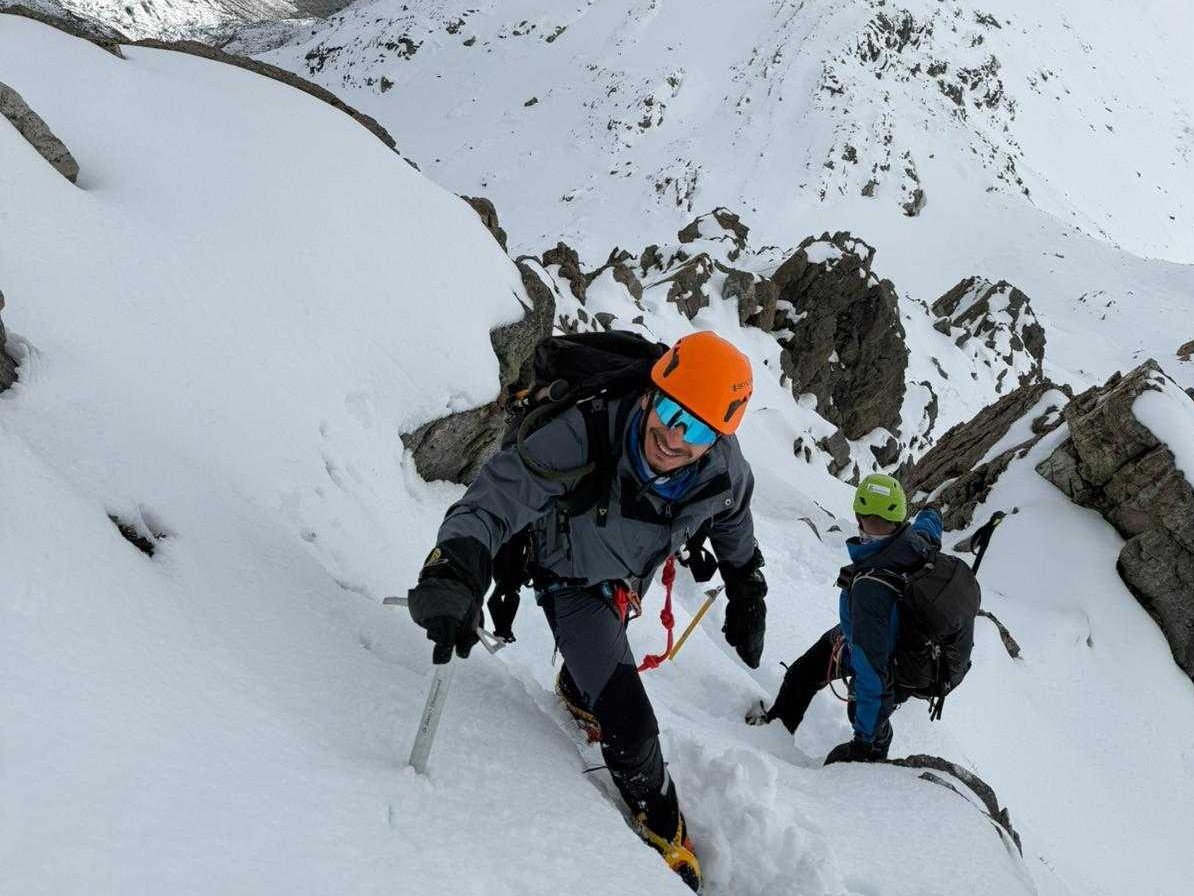
Summiting in New Zealand.
Volleyball is my other constant. I've played competitively for years and still play regularly — it's one of the few things that reliably gets me away from a keyboard and into something that requires actual spatial awareness and fast reaction time. Which, come to think of it, is also what I try to build into robots.
The combination of physical discomfort and technical problem-solving probably explains why I ended up in autonomous systems.
--
This blog
Autonomous Stack exists because I kept finding that the interesting problems — the ones worth writing about — happen in the space between the paper and the hardware. The gap where the math assumes things the real world doesn't provide, where the model that scores beautifully on a benchmark fails on your specific sensor configuration, where the system that works at 1 Hz needs to work at 30 Hz and suddenly nothing is the same.
Every post here comes from something I actually built, broke, debugged, or spent an unreasonable amount of time understanding. The writing assumes you're an engineer or researcher — equations appear when they clarify, code appears when it matters, and the goal is always to go one layer deeper than the tutorial version of a topic.
If something here is useful to you, I'd genuinely like to know. You can reach me on the links below.
Jacob Y. Autonomous systems engineer · MSc ML researcher · Climber